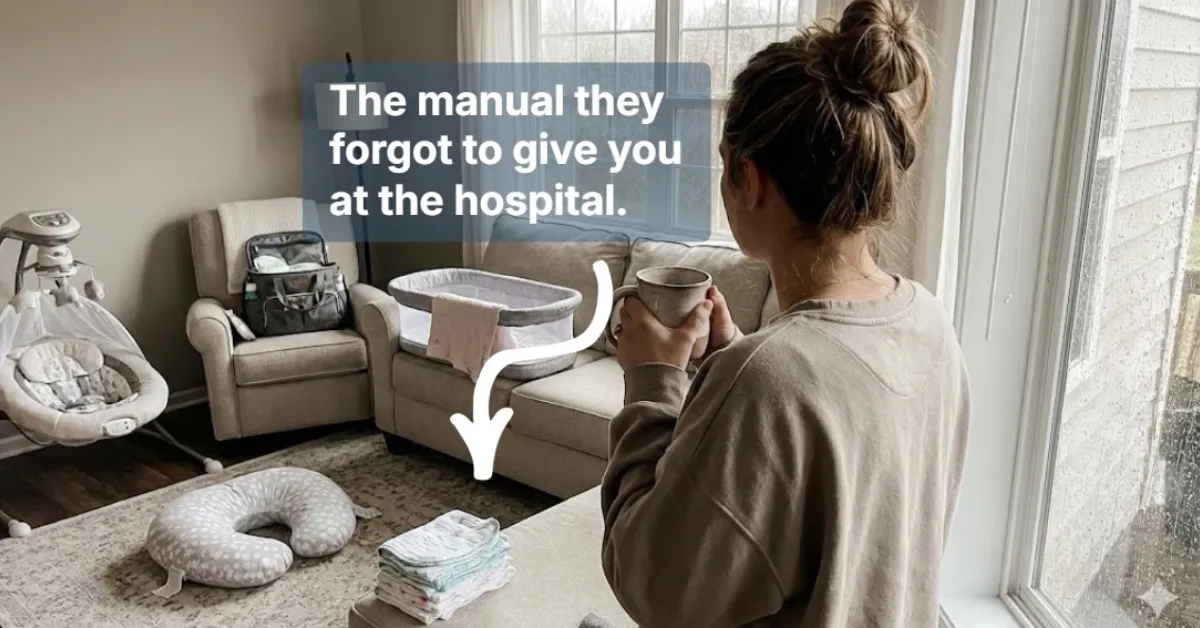
Everyone prepares you for the birth. You spent months researching the perfect stroller, packing your hospital bag, and agonizing over nursery paint colors.
But then, what comes after birth? The hospital discharge papers are signed, the car seat is buckled, and you walk through your front door. Suddenly, it hits you: Now we have to keep this human alive, and you have to heal while doing it.
Welcome to the Fourth Trimester.
It is the 12-week transitional period between pregnancy and “real life,” and frankly, it is the most under-discussed phase of motherhood. Society expects you to “bounce back.” We are here to tell you to lie down.
If you are currently reading this at 3 AM with a sleeping baby on your chest, take a deep breath. You aren’t doing it wrong. It’s just this hard.
Here is your survival guide for the first 30 days.
1. Physical Recovery: The “5-5-5 Rule”

In our culture, we praise the mom who is out at Target three days after giving birth. But physically, your body has a dinner-plate-sized wound inside your uterus (from the placenta) that needs to heal.
At The Compass Moms, we swear by the 5-5-5 Rule for radical recovery:
5 Days IN Bed: You stay in bed. Baby stays in bed. Someone else brings you food and changes diapers.
5 Days ON Bed: You can sit on top of the covers. You might move to the couch. But you are not doing laundry or dishes.
5 Days NEAR Bed: You are moving around the house for short bursts, but resting is still your primary job.
Why it matters: Rushing recovery can lead to long-term pelvic floor issues or burnout. The laundry can wait. Your healing cannot.
2. The Sleep Equation (Survival Mode)

Let’s rip the band-aid off: You will not get 8 hours of sleep. You might not even get 4 hours consecutively.
During the first 30 days, throw out the “schedules” you saw on Instagram. Your baby does not know day from night yet. Your only goal right now is safe survival.
Shift Work: If you have a partner, split the night. You take 9 PM – 2 AM; they take 2 AM – 7 AM. Four hours of uninterrupted sleep is scientifically better than 8 hours of broken sleep.
Daytime Naps: It’s a cliché, but “sleep when the baby sleeps” is real. If you can’t sleep, just close your eyes. Rest counts.
(Struggling with sleep? Check out the Find Support tab in your dashboard to connect with a certified Sleep Consultant.)
3. Setting Boundaries (The “Visitor” Problem)

Everyone wants to come see the baby. But holding a baby is easy; holding space for a healing mother is hard.
If having visitors drains you, you are allowed to say no. In fact, you must say no to protect your mental health.
Copy/Paste these scripts if you’re too tired to think:
The “Not Yet” Text: “We are soaking in these first few weeks as a family of three and aren’t taking visitors just yet. We will let you know when we are ready!”
The “Helpful Visitor” Text: “We’d love to see you! Since I’m still recovering, we’re keeping visits short (30 mins). Also, if you’re stopping by, would you mind grabbing us a coffee?”
4. The Emotional Rollercoaster: “Baby Blues” vs. PPD

Around Day 3 or 4, your hormones will crash. You might cry because you dropped a sock. You might cry because you love the baby so much. You might cry because you miss your old life.
This is the “Baby Blues,” and it affects up to 80% of new moms. It usually fades within two weeks.
However, if you feel:
– A persistent fog that won’t lift after 2 weeks
– Intense rage or irritability
– Thoughts that you “aren’t cut out for this”
This could be Postpartum Depression (PPD) or Anxiety. It is common, it is treatable, and it is not your fault. Please reach out to your provider or find a mental health professional in our Directory immediately.
You Are Not Alone in This
The transition from “Me” to “Mom” is the biggest identity shift of your life. It is messy, beautiful, and exhausting all at once.
You were never meant to do this in isolation. You were meant to do it in a village.
📥 Get The Full Manual
This was just the start. We have put together a comprehensive First 30 Days Survival Guide PDF that includes:
– A full checklist for your physical recovery kit.
– More scripts for setting boundaries with in-laws.
– A “Partner Check-In” guide to keep your relationship strong.